This gallery contains 1 photo.
Sheltered Garden (excerpt) by H.D. (American poet, novelist, and memoirist,1886-1961) For this beauty, beauty without strength, chokes out life. I …

11 Saturday Nov 2023
Posted in Autumn, Filipino, garden, Poetry Translation, Tagalog
This gallery contains 1 photo.
Sheltered Garden (excerpt) by H.D. (American poet, novelist, and memoirist,1886-1961) For this beauty, beauty without strength, chokes out life. I …
17 Thursday Sep 2026
Posted in #Transcreation, Filipino, Philippines, poem, Poetry Translation, Tagalog, translation
Tags
birds, faith, Filipino translation, Fillipino, poem, poems, Poetry, psalm, sparrows, Tagalog, Tagalog translation, transcreation, translation, wheelbarrow, William Carlos Williams
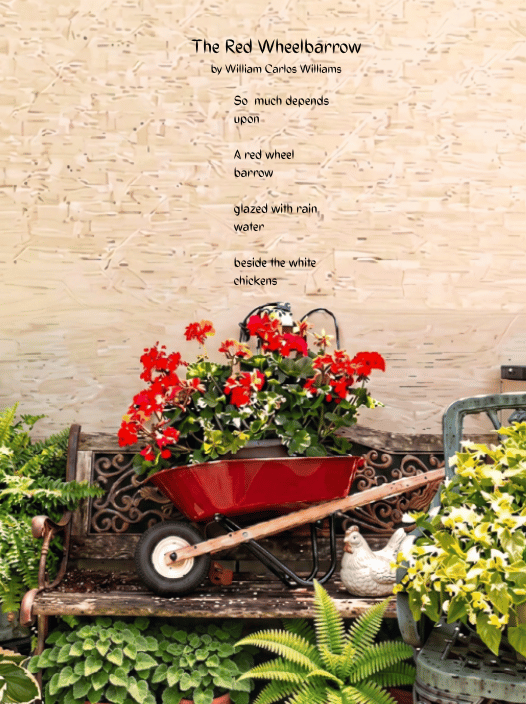
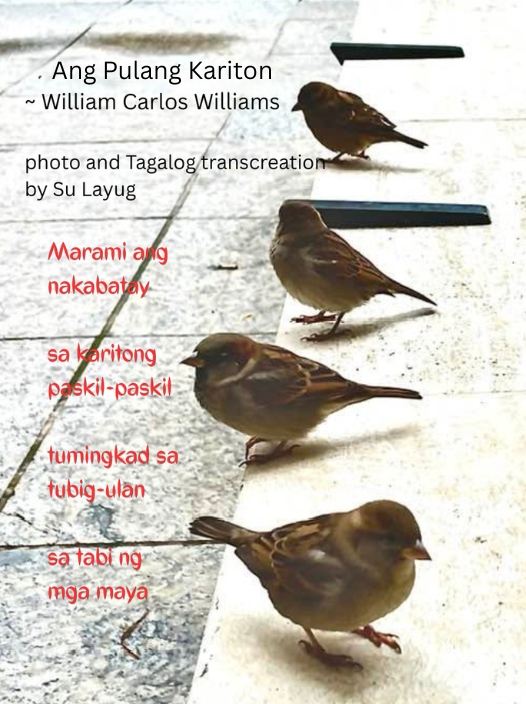
Today, I was delighted to discover that Poetry Foundation posted William Carlos Williams’ “A Red Wheelbarrow.” I’ve always wanted to translate/transcreate this poem. The challenge I had was multifold:
1. I didn’t realize until now that the poem had already been in public domain. Before that, translating it partially would’ve really done nothing since it’s very short.
2. So much depends (haha, yes, the phrase applies) on the transfer of the cadence and brevity of the poem, while, at the same time, delivering a statement to the target audience: my Filipino readers. Imagery alone, in my belief, would not make sense in the transfer of meaning and relevance. There has to be something else. A sort of touching base in that short burst of imagery.
3. It had taken me some (more) level of maturity to dare transcreate rather than merely translate poetry. These days, I look into finding resonance between the mundane and the transcendent. In this poem, I was trying to find the tie between the American ordinary and the Philippine everyday. Maybe these are my years of going back to my roots while struggling to stay anchored to the here and now. In the process, here is what I came up with:
NOTES:
Use of AI disclosure: The wheelbarrow photo was an original photo by the author, partially AI-edited with Canva (app) to render suitable for juxtaposing the poem. The sparrow photo is an original photo by the author, NO AI WAS USED in the sparrows photo nor in the translation/transcreation of the poem.
03 Friday Jan 2025
Posted in Poetry Translation
Tags
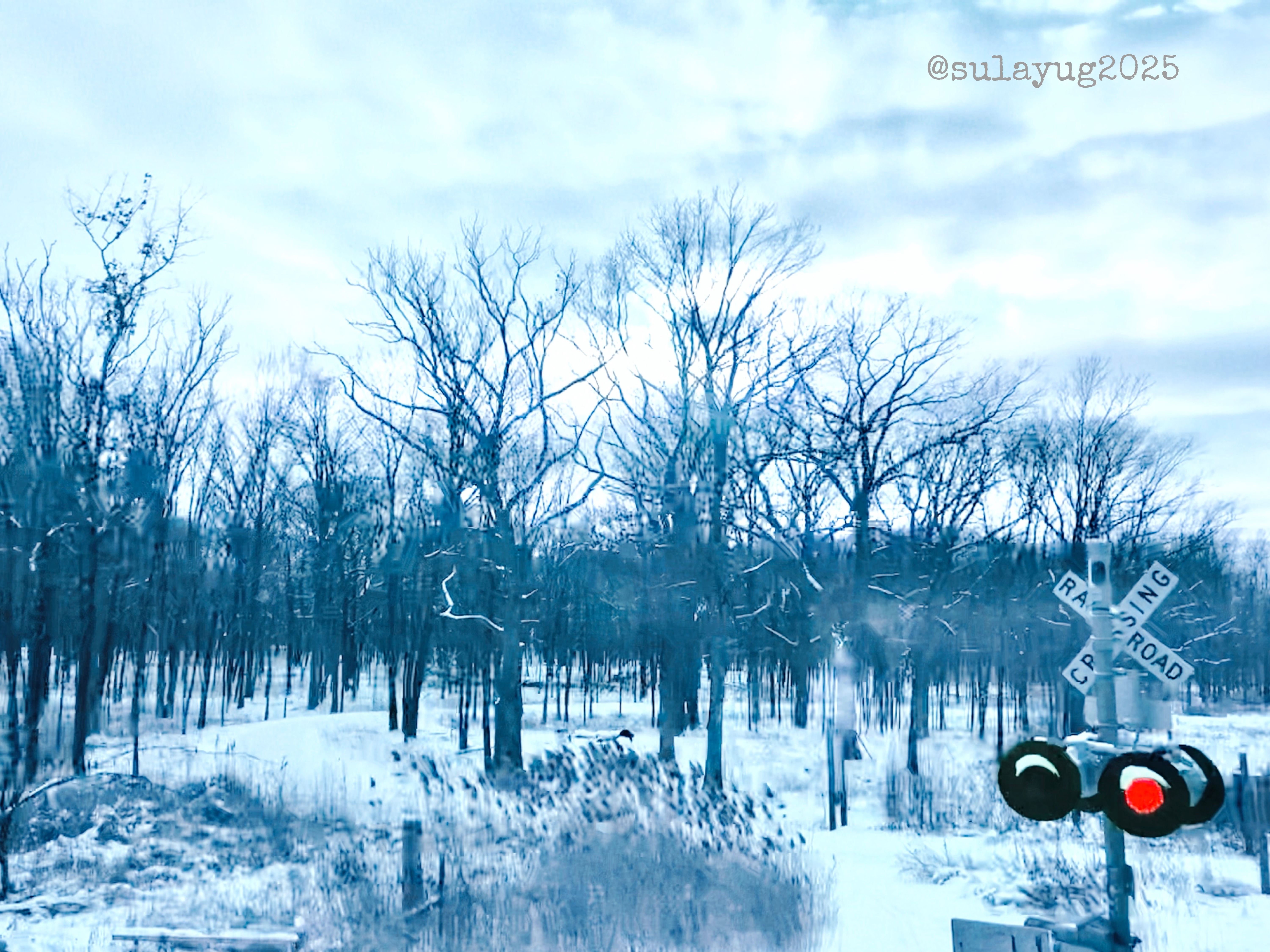
2025, birds, cosmic wisdom, death, Filipino, Filipino translation, flourishing, grieving, lark, life, Margaret Avison, mindfulness, new year, Poetry, recovery, renewal, snow, starling, swallows, Tagalog, Tagalog translation, translation, Winter
          Naaalala ko
Ang bigat-balaning halimuyak ni Anne, ang di-matinag na puntod
Na mumunti lamang ang nakukupkop ng lamig;
Magiliw kong binabakas ang mga bungo at brasong buto
Mga anyong kinahig ng mga kulansiyang at langay-langayan, sa pagkuha nila ng rabaw,
At ang mahabang silo ng amihan
Nililinaw ang pagkurba ng arko nito, mula sa bituing Arcturus
Hanggang sa laryong kanto ng patyo,
At sa pasimanong walang-galaw.
         Malumanay at makatarungang kasiyahan
bilang nilalang ang makamit mula sa kalawakan
Itong maligamgam at napagnanahanang kalooban
Na tahimik na sumasalamin sa sinag
ng (harayang) niyebe, at ng bagong taon.
             I remember
Anne’s rose-sweet gravity, and the stiff grave
Where cold so little can contain;
I mark the queer delightful skull and crossbones
Starlings and sparrows left, taking the crust,
And the long loop of winter wind
Smoothing its arc from dark Arcturus down
To the bricked corner of the drifted courtyard,
And the still window-ledge.
             Gentle and just pleasure
It is, being human, to have won from space
This unchill, habitable interior
Which mirrors quietly the light
Of the snow, and the new year.
Translator’s notes:
One of the challenges of translating from a language of one climate zone to another of a different climate zone is the concept of the seasons. The original English was clearly written in the context of the temperate zone of the northern hemisphere where snow commonly exists at the turning of the year, whereas Filipino / Tagalog is a language from a tropical climate. Two considerations:
1) the migration of birds, which is, to me, a central concept in the passing of time and the subtle shifting of sentiments, whether natural or induced, is seen by this translator as crucial in the portayal of emotional flourishing–and survival. The lark is perceived as the common-and-yet heroic bird, rising at the dawn of day, a natural bringer of joy with its songs, cited in many poetic lines, such as Shakespeare’s Sonnet 29. The starling, in contrast, is the less-than-heroic one which tends to be destructive to fruits and other vegetation, and yet is remarkable in its mimicry of other birds and sounds, as though such pretense is crucial for existence, even survival.
The translation, to Filipino, however, does not equate to the actual names of the birds. Though also migratory, the Philippine starling (kulansiyang) remains the less-than-heroic one, with its noise-making as its most recognizable feature, though not the mimicry of the northern hemisphere starling. The langay-langayan, which is the equivalent of the swallow (and not the lark), is the more graceful, poetic bird in this translation. It is usually associated with grace, hope, and renewal.
2) In translating “snow” I have opted to include the notion that “niyebe” (Spanish-derived word for “snow”) may be imagined as signified by the parenthesized word “haraya” (imagined). With this duality, the context then shifts back-and-forth from the experience of a Filipino who may have never left the Philippines, but is intellectually familiar with snow, to that of a Filipino who has migrated to a country where snow is a real experience. In either case, the experience of snow as part of the awakening, and/or survival/recovery/grieving/flourishing/renewal process, in its complexity, is real, whether to a migratory or a colonized mind, or both
The full English poem can be read here: https://www.poetryfoundation.org/poems/51733/new-years-poem?utm_source=Poetry%20Foundation&utm_campaign=bc1922be67-NO_TITLE&utm_medium=email&utm_term=0_ff7136981c-bc1922be67-185698833&mc_cid=bc1922be67&mc_eid=3b56d6ba23
05 Friday Jul 2024
Posted in Poetry Translation
Tags
A Proclamation for Peace, Allison deFreeses, Filipino translation, Kim Stafford, literary translation, Peace, poem, Poetry, Tagalog translation, Translations, World Literature Today

Tagalog Audio of A Proclamation for Peace | Read by Su Layug
This translation has been featured in the July/August 2024 issue of World Literature Today, as one of the eight select translations of the original English poem, compiled by Allison deFreese. A book of the poem by Kim Stafford and over 40 languages of translation, including links to their audio, is forthcoming in late 2024. The English original and other translations in World Literature Today are linked below. The poem in English and select translations are accessible without a paywall for the first few times.

Isang Proklamasyon para sa Kapayapaan
(A Proclamation for Peace by Kim Stafford,
translated to Tagalog by Su Layug)

Bagaman at dahil isang nagliliyab na bahay ang mundo;
Dahil at bagaman sukdulan ang mga bansa sa sigawan;
Bagaman at dahil wari’y maliit ang pag-asa, minsa’y
nag-iisang ibon lamang sa kawad
na napag-iwanan ng migrasyon.
Dahil at bagaman bihira ang kagandahang-loob sa balita
at isang ideyang halaw lamang ang kapayapaan
habang ang digmaan nama’y tunay;
Bagaman at dahil mga salita lamang ang taglay ko;
Dahil at bagaman maikli lamang ang buhay ko;
Bagaman at dahil natatakot ako;
Dahil, bagaman, sapagkat ako’y malaya –-sa gitna  ng lahat
ng apoy at galit at takot;
Kung kaya sa gayo’y napagpasyahan na isang awit
ang aking magiging lunggati–-isang awit
na hindi pa buo ang siyang magiging bokasyon
at mapapayapang salita ang magiging likhain
ng mga nalalabi ko pang araw.
World Literature Today
11 Sunday Feb 2024
Posted in Poetry Translation
Tags
death, Filipino, Filipino translation, grief, literary translation, melancholy, Poetry, Robert Cording, Tagalog, Tagalog translation, translation
A Translation from English to Filipino by Su Layug
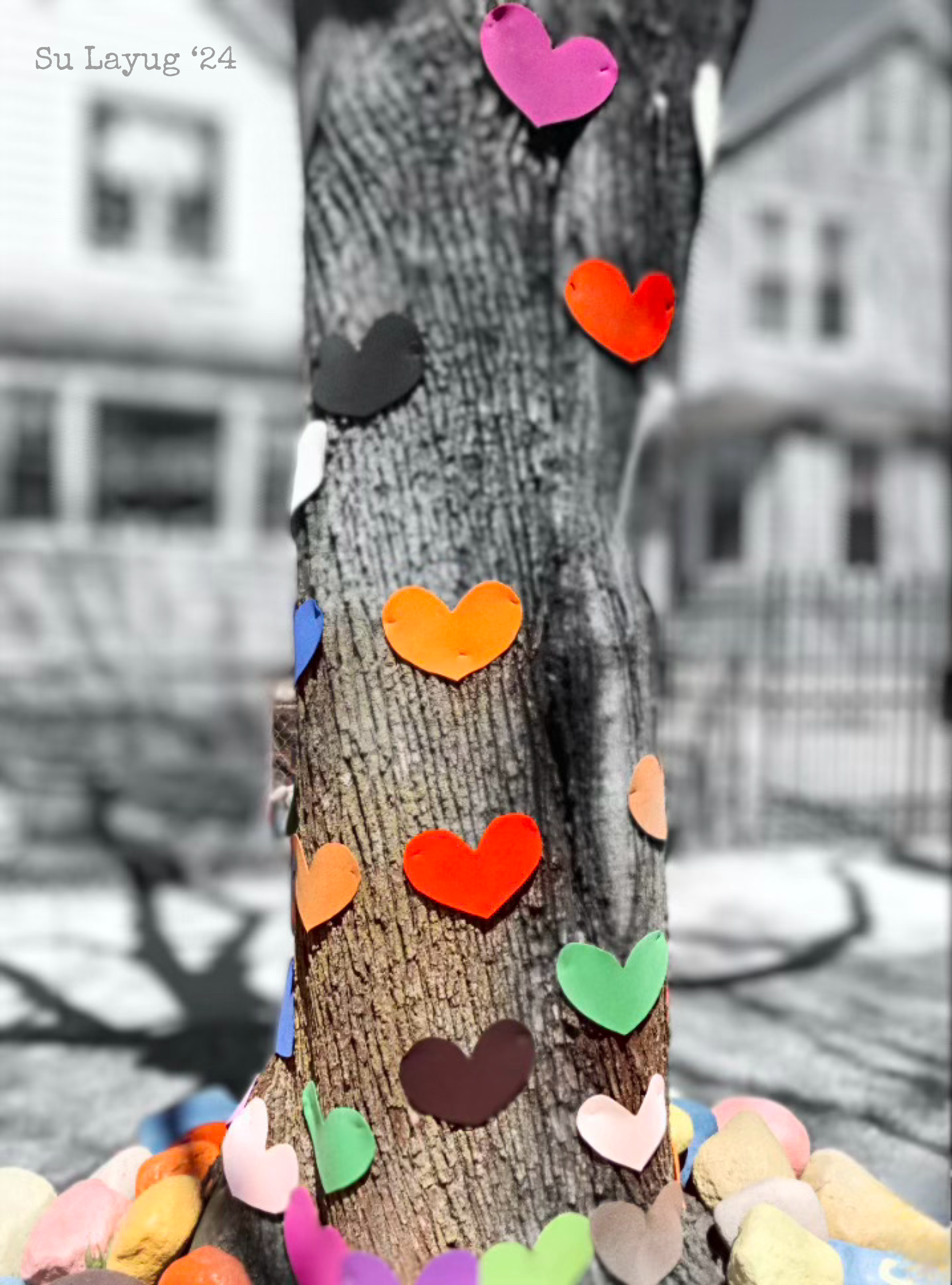
Kabilang ako ngayon sa sarili kong anatomiya ng lumbay—

Sa tagal nitong paghihintay sa hindi mangyari-yari

Sa pagtrangka nito sa kinabukasan. Sa pagkaalam nito

sa lagpas-kamatayan na hanggang doon na lang

ang alam. Ang pagkainutil nitong kumpletuhin

ang buhay na basta na lamang nagwakas. Imahe ni Durer,

may pakpak ngunit paralisado, napupung-aw, nakalatag

ang mga kagamitan sa harap niya, ngunit hindi makalikha. Ang mga salitang ito

na wari’y mga insektong nagkukubli ngayong dapithapong taglamig.
I belong today to my own anatomy of melancholy—

its long wait for what never happens.

Its shut down of the future. Its after-

knowledge of death that knows no more

than it did before. Its inability to complete

a life that simply ended. Dürer's figure,

winged but paralyzed, moping, tools spread

before him, but unable to create. These words

that lurk like insects this winter late afternoon.
Translator’s Notes:
1 “Hindi mangyari-yari” — the repetition of the root word, “yari” (to happen) at the end denotes the (non-) fruition of the action verb “happen.” (“that never happens”). An alternative is to say “hindi mangyayari” (will never happen) but the earlier phrase, “hindi mangyari-yari” suggests a recurring wish for something to happen, and the recurring end-result of that something never happening.
2. What I found especially difficult to translate are the lines, “Its after-/ knowledge of death that knows no more / than it did before.” The question arises: what does “that” refer to?” Does it refer to “melancholy,” to which the persona belongs to, and thus represents them? Or does it refer to “after-knowledge” (that knows no more than it did before)? I took the liberty of interpreting “that” as referring to “melancholy” which existed before and after the death being talked about. Thus, the Filipino translation, “sa kaalaman sa lampas-kamatayan” (the knowledge of (what is) beyond death) “na hanggang doon na lang ang alam” (which is its (melancholy’s) limit of knowing)
3. Through Cording’s article (a personal essay, its link below), which I found online after writing this translation, we can confirm that this poem is an autobiographical one — that, indeed, it refers to the death of Cording’s son. The poem refers to the visual artist Albrecht Dürer‘s work Melencolia (1513/1514) in the last stanza. The grief of the persona due to the death of his son is juxtaposed with his grief of not being able to create, juxtaposed with the realization that his son, himself, will no longer be able to create, his life having been taken too soon.
4. I chose to say, “Filipino translation,” rather than “Tagalog translation” because I chose to use the word, “napupung-aw” (moping, being melancholic) which is not Tagalog, but Bicolano — the native language of my late mother. I wish I learned her language more.
This is the link to the whole poem in English: https://poems.com/poem/melancholys-mirror/
This is the link to Robert Cording’s personal essay, In the Unwalled City: https://imagejournal.org/article/in-the-unwalled-city/
11 Thursday Jan 2024
Posted in Poetry Translation
Tags
#Friendship, #Unrequited Love, FilipinoSong, FriendofMine, Love, music, OdetteQuesada, Tagalog, translation
Composed and sung originally in English by Odette Quesada, translated to Tagalog and sung in Tagalog by Su Layug.
Lately I find myself translating English songs to Tagalog. I find this task extra challenging on a couple more levels than translating poetry. My self-imposed challenges are the following:
The originally English song that I’m featuring here was composed, recorded and immortalized by Odette Quesada — an icon in the Philippine music industry. I chose this particular song as my first (public) adventure in song translation because it has a personal back story, not in the sense of the song’s meaning – a one-sided romance between two friends – but in the twists and turns of friendship and romance that childhood friends sometimes get intertwined in. Many times, these love triangles are not as obvious as the coming-of-age Hollywood movies portray them to be, nor quite as well-defined as the triangle imagined by the non-recipient of the unrequited love. In any case, I’d like to think that in such love-and-friendship stories, friendship ultimately prevails, as it is, in many times, greater and more enduring, than romantic love.
Aking Kaibigan

Kaibigan ka noon

Kaibigan pa rin ngayon

Hanggang kaibigan na lang nga ba tayong dalawa?

Mahal kita noon

Mahal pa rin ngayon

Ngunit gayunpama’y kaibigan lang pala.

Pag-ibig mo’y sa kanya lang,

Pag-ibig ko’y sa iyo laan

Ngunit kapag malungkot ka,

Lagi akong nandiyan


Ako ang siyang takbuhan mo,

Kakwentuhan ng lambingan niyo,

Ngunit di mo man lang pansin

Ang damdaming nananaig

Sa iyo’y nananabik

Ngunit heto pa rin ako.


Excerpt of the original English, A Friend of Mine
Music and lyrics by Odette Quesada

I've known you for so long

You are a friend of mine

But is this all we'd ever be?

I've loved you ever since

You are a friend of mine

But babe, is this all we ever could be?

You tell me things I've never known

I've shown you love you've never shown

But then again, when you cry

I'm always at your side

You tell me 'bout the love you've had

I listen very eagerly

But deep inside you'll never see

This feeling of emptiness

It makes me feel sad

But then again, I'm glad
To put to the test the viability of the translation, I sing the translated song in a lower key than the original singer does (I am an alto).
Here’s a link to Odette Quesada’s Facebook, where a video of her recent rendition of this song in the original English is posted: https://www.facebook.com/odetteq
15 Sunday Oct 2023
Posted in Filipino, Micropoetry, Poetry Translation, Tagalog, Twitter Poetry
(in English and Tagalog)
The Twitter poetry tradition goes back to when the then-Twitter (now X) platform posed a challenge to poets to write within its restrictive 140 characters, to when the character count expanded to 280, and to now, when the longer form is allowed for premium subscribers.
I continue to write in the restrictive form of 280 characters or less, being used to delivering poetic thoughts in bursts of Tweets, albeit they are no longer called that.
As a Tagalog translator, I (human) also translate my English tweets to this Philippine language, constantly comparing it to the renditions of Google Translate or Bing Translate, which are readily available on The X platform, itself. The evolution of AI in translation is part of my self-study as a translator and as a poet.
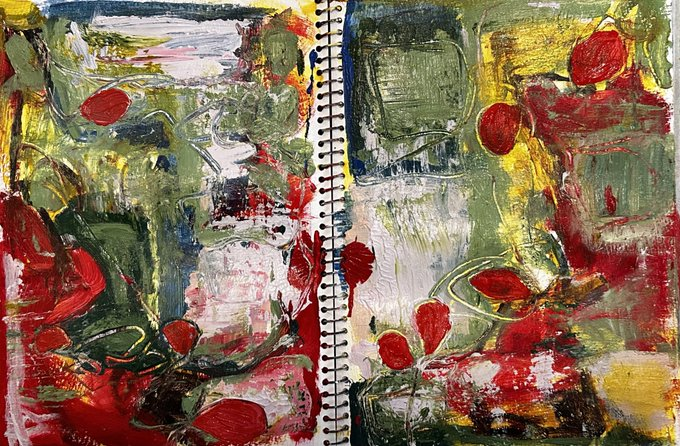
“Rose Gardens” (mixed media on watercolor paper) by ThompsonNFT on Twitter / X with the author’s permission https://twitter.com/thompsonNFT/status/1713194138869387659/photo/1
The Roses Bleed

onto the page of autumn
where bleeding is allowed
with abandon
in grief, in passion, in remorse --
or to let stand still
what briefly was or what could've been
in a tiny light --
that it may perchance, shine --
another time. Again.

~ Su Layug
Nagdurugo Ang Mga Rosas

sa pahina ng taglagas
kung saan hinahayaan ang pagdugo
nang walang pakundangan
nang dahil sa dalamhati, pusok, pagtitika --
o upang patirikin lamang
ang isang saglit, o ang isa sanang saglit --
nang harinawa'y,
isang araw
ito'y muling magningning.

~ Su Layug
06 Wednesday Sep 2023
Posted in creative writing, Filipino, Poetry Translation
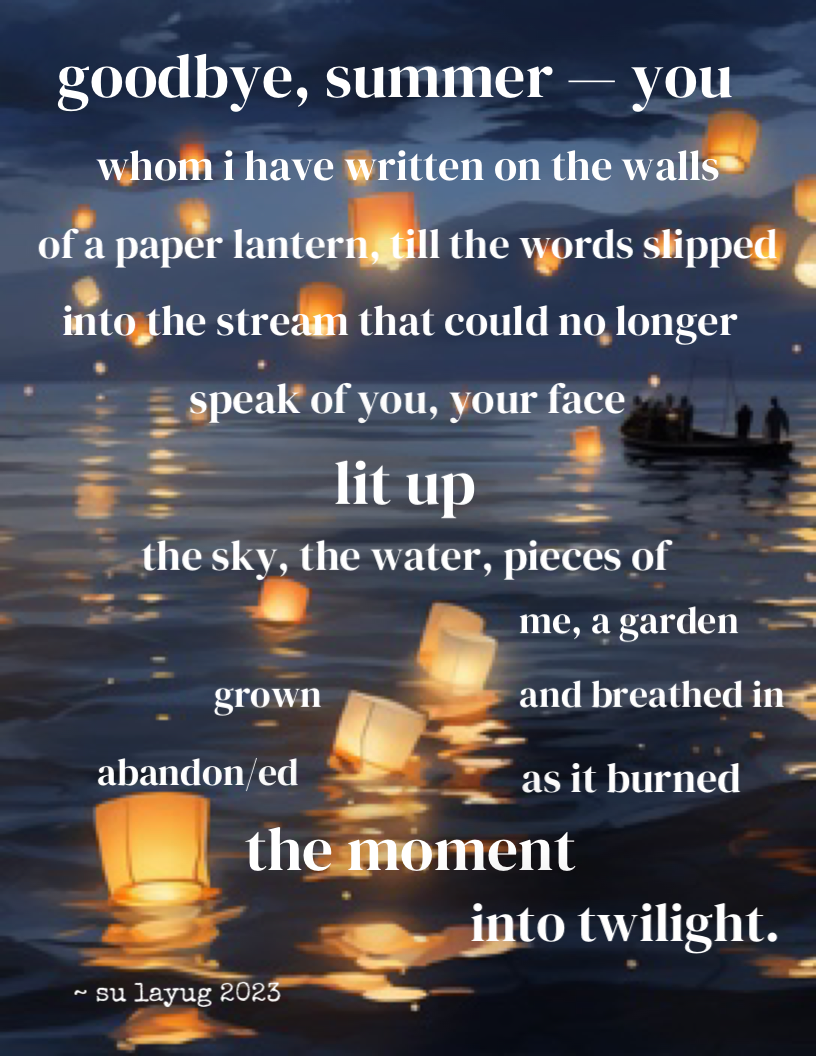
Paalam, Tag-init – ikaw
na isinulat ko sa mga dingding
ng lamparang papel, hanggang pumanaog ang mga salita
sa daloy na hindi na/kayang
bigkasin ang ngalan mo, ang iyong mukha/ng --
suminag sa langit at tubig. mga piraso
ng pagkatao ko – isang hardin
na lumago at huminga/inihinga
nang walang pag-aalala o alinlangan/iniwan
habang pinaliliyab ang sandaling
padapithapon.

translated to Tagalog/Filipino by Su Layug
18 Thursday May 2023
Posted in Poetry Translation
(excerpt) Poetry Translation
BY LYN HEJINIAN
The leaves outside the window
tricked the eye, demanding that one see them, focus on them,
making it impossible to look past them, and though holes
were opened through the foliage, they were as useless as port-
holes underwater looking into a dark sea, which only reflects
the room one seeks to look out from. Sometimes into
benevolent and other times into ghastly shapes.
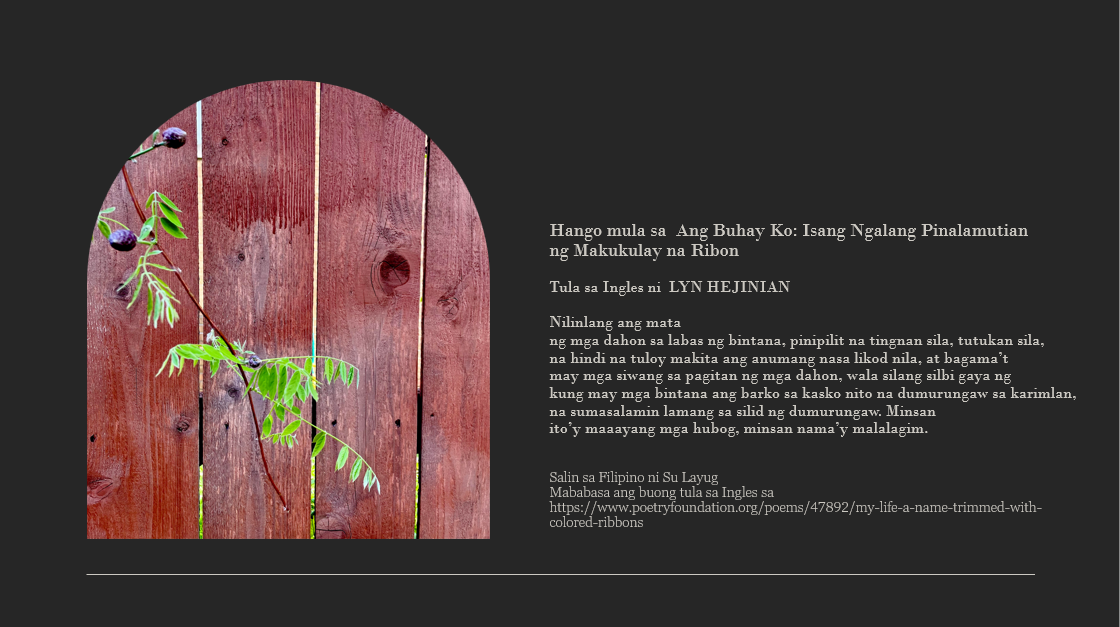
The full text in English can be found at Poetry Foundation: https://www.poetryfoundation.org/poems/47892/my-life-a-name-trimmed-with-colored-ribbons
Translator’s notes:

18 Wednesday Jan 2023
Posted in creative writing, Poetry Translation, Tagalog, translation
by Su Layug (also published here: https://medium.com/ai-poetry-and-art)

(AI-co-created image using the author’s own photograph)
Resplendent fragile creature,
you are the light and beauty that you seek,
when your sanctuary walls have shed,
and the almighty sun has blessed you,
come out and grace our world.
You’ve always belonged here, too.
Maningning na talusaling,
ikaw ang ilaw at gandang hanap mo.
Sa pagbaklas ng santuwaryo mong dingding,
at sa pagpapala ng bathalang sinag,
sumilip ka’t sumali sa aming mundo.
Ito ay mundo mo rin.
Translator’s Notes:
There is a dual or even triple tense/mood in the translation that is not in the original English. Back-translated, the lines can be read in the present: “As your sanctuary walls are shed […] you (now) look outside and join our world.” It can also be back-translated in the imperative mood this way: “When your sanctuary walls will have been shed […] look outside and join our world.” Or alternatively, in the past: “When your sanctuary walls were shed […] you looked outside and joined our world.” And so we find it here that as we switch languages, we switch our paradigms of time, too. And with these, also our worldview. How often do we find that, when we leave our psychic cocoons, we sometimes weave another one into which we retreat, and from which we reemerge (if we ever do) when we are ready to face the world, once again? Life is a constant cycle of advances and retreats, it seems, and we are never finished evolving and devolving until we cease to exist. And even after then, who knows?
 waterjug